
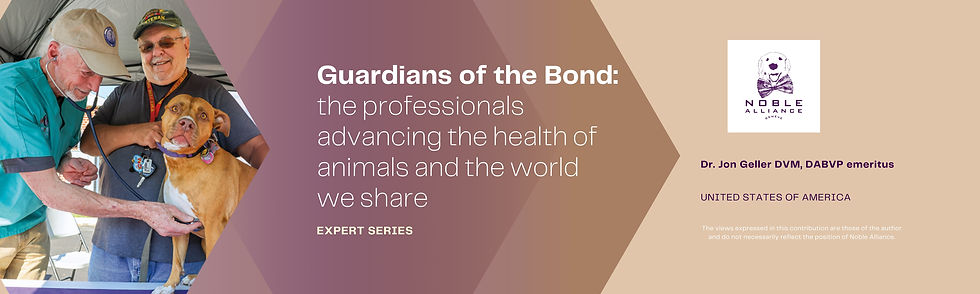

Dr. Jon Geller DVM, DABVP emeritus
The views expressed in this interview are those of the interviewee and do not necessarily reflect the official position of the Noble Alliance Association.
When Veterinary Care Meets the Street, and the Human–Animal Bond Becomes a Lifeline
Three Dog Night: Caring for Pets of the Homeless
It was a warm, humid afternoon in Nashville, Tennessee as I walked across an arched foot bridge near the river. As I crossed, I noticed a man and his dog sitting on the bridge; he was clearly homeless, as all of his belongings were nearby. His pit bull appeared friendly, but instinctively I was wary. The man and his dog seemed content, without any look of expectations or resentment, often apparent among those struggling to find their next meal. We all locked eyes and wordlessly I heard the man say, ‘Can you do something’.
I left the bridge and thoughts swirled through my head. As a veterinarian, I imagined, then realized, that the man was asking me if I could help other people and their pets in living on the streets, indigent, without knowing where they would sleep that night, and enduring the stigma and rejection associated with homelessness.
The Street Dog Coalition was born in 2015, starting with a small free street clinic in Ft. Collins, Colorado where a team of volunteers provided free checkups, vaccinations, parasite control and treatment of maladies for pet owners experiencing, or at risk of homelessness. We quickly learned that many pet owners were more concerned with their pets’ health, often to the detriment of their own.
Homelessness is everywhere in the US, with an estimated one million people lacking permanent housing at any one time. Their lives are hard, and owning a pet makes a hard life even harder. With your pet at your side 24/7, you likely would not be going into a doctor’s office, a grocery store, a library, a coffee shop, a convenience store. The large majority of homeless shelters don’t allow pets, except service animals which are few and far between. Most pets who can not fit in a small crate below the seat are not allowed to ride on public transportation.
The paradox is that pets can provide a lifeline, for many homeless pet owners. They provide unconditional love, purpose, companionship, protection and nighttime warmth. The 80’s rock and roll band Three Dog Night knows about this. Pets help help their unsheltered owners navigate the dangers of inner cities and remote woods.
Take John Mark and his dog Cowboy. John Mark has been struggling with homelessness for over 15 years. His previous dog, Max, had to be euthanized due to an inoperable condition. Within two weeks, John Mark found Cowboy, a large yellow lab mix, at his door with a note asking him if he would care for the dog. His owner had recently taken his own life after a tour of duty in Afghanistan, and his relatives knew about John-Mark’s recent loss of Max.
John Mark has now found modest housing, and he and Cowboy are inseparable. His life revolves around him, perhaps precariously so because Cowboy is getting up there in age. Although organizations like The Street Dog Coalition can provide preventive care and treatment of minor maladies, a true emergency may result in economic euthanasia, and unfortunately common occurrence in the increasingly expensive world of veterinary medicine.
Ironically, many dogs may have happier lives living on the streets with their owners then our own pets who may be spending many hours on the couch waiting for us to come home from work.
Pets of those living on the streets are with their owners 24/7, enjoying continuous companionship. They are active, engaged and socialized. They are well-fed, as they usually get whatever food is available before their owners. Their body condition scores usually reflect a healthier weight than our own dogs, who often suffer from obesity.
Military veterans struggling with homelessness can be especially bonded with their pets, forming a ‘pack of two.’ I remember one elderly and grizzled veteran who was at one of our street clinics holding his dog and saying “if anything happens to Buddy, I would…” and he held up one of his wrists and made slashing movements across it with his other hands.
Pets can literally be barriers to suicide.
Other veterinarians have now heard about our efforts, and asked to set up similar clinics in their hometowns. We have free monthly clinics in over 50 US cities, supported by generous donations and free supplies.
Now, ten years after the start of the Street Dog Coalition, I find myself being pulled to the other end of the leash. From a veterinary perspective, providing care to the pets of the homeless is pretty straight forward; it is the pet owners on the other end of the leash that face a constellation of challenges, including financial despair, major medical illnesses, drug and alcohol addiction and mental health disorders. Untreated, diseases like diabetes can lead to food and leg cubital ulcers making walking painful or impossible. Previous brain injury or PTSD or emotional trauma can set the stage for a life of setbacks, hopelessness and despair.
Providing care to pets of those experiencing homelessness is pretty straightforward. But their owners….that’s where the challenges lie.
A new model of care has emerged called One Health Outreach, where interprofessional teams of veterinarians, physicians, dentists and counselors , assisted by nurses, technicians and students, team up to put on free community health fairs in underserved communities.
Like at a circus, a small campus of tents arises in the morning, and is gone by darkness. A person might get a consultation with a physician, and then have their teeth cleaned, and get a haircut from a stylist while their dog or cat sees a veterinarian. Financially struggling pet owners usually put their pet’s needs above their own, neglecting their own health, especially dental care. How amazing it is to see the dental team at work in their tent with their portable prophylaxis equipment, their patient in a reclining lounge chair, perhaps with their pet in their lap.
We can learn so much from those who are out there on the streets and in the woods, often battling to just survive, sharing their lives with their pets who give them so much: unconditional love, companionship, protection and a reason to live. They exemplify the resiliency and power of the human animal bond. In some ways, we are all in this together.


