

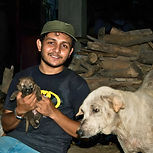
Dr. Mujib Rahman DVM, MS
The views expressed in this interview are those of the interviewee and do not necessarily reflect the official position of the Noble Alliance Association.
What I Learned Fighting Rabies: A Young Professional on Fixing Systems Not Designed for Care.
As someone who came into veterinary school with curiosity and drive, what pushed you to found the Bangladesh chapter of the International Veterinary Students’ Association and what did that early organizing teach you about what’s missing in the current system?
During my DVM internship, I volunteered with Mission Rabies, a UK-based animal charity focused on eliminating rabies through mass dog vaccination and education campaigns. While working on their education program in Goa, India, I met Dr. Fredric Lohr, who introduced me to the International Veterinary Students’ Association (IVSA). He shared the contact for the responsible officer, and once I returned home, I reached out. With the support of our dean and faculty at the Faculty of Veterinary Medicine, I and a few fellow DVM students took every step necessary to establish the first official IVSA Bangladesh chapter at Chattogram Veterinary and Animal Sciences University (CVASU). Today, eight local chapters are operating under this umbrella. That experience taught me the value of structure, initiative, and how much untapped energy exists in young professionals when they have the right platforms.
You're building your career in a context where veterinary education often overlooks companion animals. What do you think needs to change?
Bangladesh is the eighth most populous country in the world, and understandably, our veterinary education has long focused on food animals. Companion animals were often considered peripheral. But that is beginning to shift. As demand grows, this sector is becoming more visible. One key issue is that the existing organogram of our Department of Livestock Services doesn’t adequately address national needs. A policy-level extension of this department could open doors for sustainable change in companion animal care.
You’ve worked on national rabies strategies and mass vaccination efforts. What’s it like to be a young professional trying to shape systems that weren’t designed with compassion or prevention in mind?
My first professional job was with Dogstar Foundation in Sri Lanka, where I sterilized dogs via mobile spay units. Since 2017, I’ve been part of Bangladesh’s National Rabies Elimination Program—a government-funded, One Health-based initiative. This position has allowed me to support planning efforts from rural villages to national levels and to contribute to policies through advocacy and stakeholder engagement. I’ve helped develop national guidelines, standard operating procedures, and strategic plans for zoonotic diseases, especially rabies. It hasn’t always been easy, but being part of that policy infrastructure has been empowering.
From the rooftop farms in Dhaka to fieldwork in Saint Martin’s Island, you’ve seen different faces of animal life in Bangladesh. What are you noticing about how the role of companion animals is changing—and how society is (or isn’t) keeping up?
Bangladesh has a growing demand for safe protein, which means even urban spaces like rooftops are being repurposed for farming. A well-integrated rooftop farming model can generate income while contributing to city-based food supply chains. Meanwhile, on Saint Martin’s Island—our only coral island—dog overpopulation has become a major ecological and public health issue. The area is rich in biodiversity, and overpopulation affects sea turtles, marine life, and human safety. With WHO support, I worked on a comprehensive study assessing dog population dynamics, bite incidents, and ecological impact. The goal was to pilot a humane dog population management (DPM) strategy—including an ABC (Animal Birth Control) program—to improve both dog welfare and public safety on a national level.
Whether through a school campaign or your role in community education, you’ve connected with thousands of people. What has surprised you most about how people relate to dogs, even when they have very little?
School campaigns are one of the most effective ways to build mass awareness around dog welfare and rabies prevention. Many people still misunderstand or neglect dog bites, which can be fatal due to rabies. Education changes that. I’ve been surprised at how receptive children are. They become more dog-friendly almost instantly. As a result of these campaigns, I often receive phone calls from people seeking advice on dog bites or bringing their animals to clinics. That shift in behavior is promising.
As someone who’s learning through action—both in Bangladesh and with global partners—what do you think younger vets bring to the table that older systems often miss?
Many young vets still operate within narrow definitions of their roles. They don’t always think beyond clinical duties to understand their potential in public health and policy. Developing strong communication skills can bridge that gap. It enables young professionals to plan better, advocate more effectively, and contribute to disease control efforts on a larger scale.
You care about science, but also about stories. In your writing and your work, how do you try to shift how people feel about animals—not just what they know?
Policy-level change starts with public voices and demands. I use stories to bridge that gap—to connect people with the science, and to help them recognize their own needs in those narratives. When people truly understand an issue—not just factually, but emotionally—they begin to speak up. And in a country like Bangladesh, where change often starts from the ground up, those voices are essential.
Bangladesh is facing climate, health, and equity challenges. How do you think pet care and the human-animal bond can actually be part of the solution?
One important step is encouraging people to adopt native breeds. Many families prefer foreign breeds, which aren’t always suited to our climate and require more resources. In the end, breed doesn’t matter—what matters is care and welfare. Shifting public attitudes in this direction can make pet care more sustainable and inclusive.
You're growing up professionally in a time of big uncertainty—but also big ideas. What’s the boldest thing you believe about the future of pets, people, and policy in Bangladesh?
Alongside like-minded animal advocates, I founded PranisebaTrust, a non-profit aiming to promote sustainable animal welfare in Bangladesh. We envision this as a stepping stone toward establishing the Bangladesh Animal Welfare Commission. Some of our signature initiatives include the Bostami Turtle Talk, work on One Health and antimicrobial resistance (AMR), status assessments of migratory birds, and the promotion of humane Qurbani practices. I believe these are not just isolated actions but part of a broader policy movement.
If someone asked you why you're doing all this—what drives you, what keeps you hopeful—what would you say, as a next-gen Guardian of the Bond?
I love building ideas, turning them into action, and assessing their impact. That process keeps me grounded as a lifelong learner. I’ve come to believe that life isn’t about one ultimate destination. It’s a journey of continuous learning toward the places where we can do the most good. That belief drives me every day.


